Best Compact Recliner When Floor Space Is Tight

Five compact recliners compared on published height, depth and seat width figures, with a clear note on which listings actually say anything about taller frames.

By Sammy HoltUpdated 15 min read
On this page
- Best compact recliner for tall people at a glance
- Which of these listings actually mentions tall people?
- Three reasons picks got cut
- What the size figures really tell you about legroom
- 1. Cfvyne Zero Wall Power Recliner Chairs — Best overall
- 2. Korser Oversized Recliner Chair — Best for families
- 3. MCombo Compact Wall Hugger Power Recliner Chair for Small — Best premium
- 4. Yaheetech Recliner Chair with 3 Adjustable Angles Living — Best budget pick
- 5. LURVIA 75'' Manual Reclining Sofa with Storage Drawer — Most versatile
- Wall hugger or zero wall: which fits a tight room?
- What owning a compact recliner actually involves
- The verdict
- FAQ
The best compact recliner for tall people in this group is the Cfvyne Zero Wall Power Recliner, because it stacks a 39.4 in back height onto a frame just 25 in wide. If your floor plan can spare 40.9 in of width, the Korser Oversized Recliner Chair claims a 26.4 in seat and is the better pick for a shared chair. Neither is built for a 6 ft 5 in frame, and the listings here are honest about that if you read them closely.
If you're over about 6 ft 3 in and shopping strictly for legroom, this category is probably the wrong aisle. Compact recliners get compact by trimming seat depth and footrest travel, which is the exact dimension a long-legged sitter needs most. Big-and-tall recliners solve that by going wide and deep, and they need the floor space to do it. What follows is for the shopper stuck between the two: taller than average, but working with a corner rather than a room.
Best compact recliner for tall people at a glance
| Pick | Height | Footprint (W x D) | Price |
|---|---|---|---|
Best overall Cfvyne Zero Wall Power Recliner Chairs |
39.4 in | 25 x 36.6 in | Check Price |
Best for families Korser Oversized Recliner Chair |
40.6 in | 40.9 x 37.8 in | Check Price |
| 40.6 in | 35.4 x 30.7 in | Check Price | |
Best budget pick Yaheetech Recliner Chair with 3 Adjustable Angles Living |
39.2 in | 26.5 x 33.5 in | Check Price |
Most versatile LURVIA 75'' Manual Reclining Sofa with Storage Drawer |
41.3 in | 75 x 29 in | Check Price |


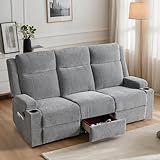
Which of these listings actually mentions tall people?
Only one. The Korser listing says the 26.4 in seat is "crafted for taller users and anyone who prefers spacious seating". That's the manufacturer's phrasing, not a verified fit measurement, and seat width helps a broad frame more than a long one.
The rest say the opposite, or say nothing. Cfvyne's own title names "small spaces and petite people". MCombo describes "well-proportioned dimensions" for "most users". Yaheetech and LURVIA publish sizes and leave the fit question alone.
So treat the search phrase honestly. Amazon returned compact recliners; it did not return chairs certified for tall sitters. When you're hunting the best compact recliner for tall people, the only numbers you can lean on are the published ones:
- Overall height, which loosely tracks how far the backrest supports your shoulders. Range here: 39.2 in to 41.3 in.
- Depth, which loosely tracks seat depth and footrest reach. Range here: 29 in to 37.8 in.
- Seat width, published only by Korser at 26.4 in and only as a claim.
Nobody here publishes a seat height, a back height measured from the seat, or a footrest extension length. Those are the three figures a tall shopper actually wants, and their absence is the real story of this category.
Three reasons picks got cut
I started from compact and wall-hugger recliners in Living Room Furniture and cut hard. Three disqualifiers did most of the work.
- No published dimensions. A recliner listing that gives a size name and no inches is useless for a tight room. Every chair below publishes width, depth and height.
- Depth under 29 in with no compensating figure. Very shallow chairs exist, and they seat a shorter person fine. For anyone with long femurs, a sub-29 in body means the seat pan ends before your knees do.
- Sofas and loveseats masquerading as chairs. I made one exception, the LURVIA, because a 29 in depth on a 75 in sofa is genuinely unusual and it solves a floor plan problem a single chair can't.
What survived is a set of five that share almost nothing else. Two are power, three are manual. Weights run from 51 lb to 211 lb, a four-fold spread. One publishes a warranty, one publishes "N/a", three publish nothing on the subject. That spread is why the picks below map to buyer profiles rather than a single ranking of goodness.
What the size figures really tell you about legroom
Here's the trick with compact recliner specifications: overall depth and usable seat depth are not the same number, and only the first gets printed.
A recliner's published depth includes the padded back, which can eat five or six inches before your body touches anything. So a 37.8 in Korser and a 29 in LURVIA are not 8.8 in apart in seat depth. They're apart by some fraction of that, and no listing here tells you which fraction.
What you can do is compare within the set. Ranked by published depth:
- Korser, 37.8 in, deepest of the five
- Cfvyne, 36.6 in
- Yaheetech, 33.5 in
- MCombo, 30.7 in
- LURVIA, 29 in, shallowest
If legroom is your priority, that order is your priority order too. Then check height. Cfvyne's 39.4 in and Yaheetech's 39.2 in sit at the bottom of the range; Korser's 40.6 in and LURVIA's 41.3 in sit at the top. A taller back is more likely to catch your shoulders instead of your mid-spine.
Measure your own seated shoulder height before you buy. It takes a minute and it's the single most useful number in this whole exercise.
1. Cfvyne Zero Wall Power Recliner Chairs — Best overall
The narrowest chair here at 25 in wide, and it still carries a 39.4 in back and motorised recline.
Best for: a narrow corner where 25 in is all you have
Skip it if: you need an extra-wide seat
The width figure is what wins this. At 25 in, the Cfvyne is 1.5 in narrower than the Yaheetech and nearly 16 in narrower than the Korser. In an apartment where a chair has to slot between a bookcase and a doorway, that difference decides whether you can buy a recliner at all.
Depth is the other half of the story. At 36.6 in, it's the second-deepest body in the set, behind only the oversized Korser. Narrow and deep is an unusual combination, and it's the geometry a long-legged sitter in a small room wants: length where the legs go, restraint where the walls are.
Cfvyne describes this as a zero wall design, arguing the base stays put when the backrest reclines. That's the manufacturer's claim, and it matters because a wall hugger still needs clearance while a zero wall design theoretically needs less. Power operation comes via a remote rather than side buttons, which the listing frames as easier for anyone short on grip strength. Assembly is described as tool-free.
The trade-off is honest and it's in the title: this chair is aimed at small spaces and petite sitters. It's the narrow-frame answer, not the broad-frame one. It also sells slower than anything else here, and only one seller lists it.
Pros:
- Narrowest footprint of the five at 25 in
- Second-deepest body here at 36.6 in
- Motorised recline with a handheld remote
- Lightest power chair in the set at 75 lb
- Tool-free assembly claimed
Cons:
- Marketed for petite sitters, not tall ones
- No seat width published anywhere
- No stated warranty
- Slowest seller of the five, and only one seller stocks it
2. Korser Oversized Recliner Chair — Best for families
The only listing here that claims a seat width, 26.4 in, and the only one that names taller users.

Best for: a shared TV chair with a 26.4 in claimed seat width
Skip it if: your floor space is under 40 in wide
Read the word "oversized" carefully, because this chair earns it in every direction. It's 40.9 in wide and 37.8 in deep, making it the largest single seat in this set by a clear margin. It's also the deepest, which is the figure that matters most for legroom.
Korser says the 26.4 in seat is built for taller users and people who want room to shift. Nobody else here publishes a seat width at all, so this is the only pick where you get any number for the dimension you sit on. The listing also describes 360-degree swivel with rocking, eight-point vibration massage, lumbar heat, dual removable cup holders and diamond-quilted PU leather. Assembly is claimed at five to ten minutes with no tools.
For a household where one chair gets passed around, that combination is hard to argue with. It's also the cheapest of the two chairs that get near a 40 in footprint, and it sells faster than every other chair here.
The catch is the word "compact". At 40.9 in wide it stretches the definition past breaking point, and 101.5 lb makes it awkward to reposition alone. Buy it for the seat, not for the floor plan.
Pros:
- Only pick with a published seat width, claimed at 26.4 in
- Deepest body in the set at 37.8 in
- 360-degree swivel plus rocking
- Heat and eight-point massage per the listing
- Sells faster than the other four picks
Cons:
- 40.9 in wide, which strains "compact"
- 101.5 lb makes it hard to move solo
- No stated warranty
- Manual recline only, unlike the Cfvyne and MCombo
3. MCombo Compact Wall Hugger Power Recliner Chair for Small — Best premium
The only pick with a published warranty, and the shallowest chair here at 30.7 in.

Best for: a shallow 30.7 in alcove with a power seat and USB ports
Skip it if: you resent paying most for the smallest footprint
MCombo is the most expensive pick here, and the specification that justifies it isn't a size. It's the 2-year limited warranty, covering the reclining mechanism, the electrical system, the upholstery and cushions, and the frame. Nothing else in this set publishes warranty terms at all. On a powered chair with a motor and a control board, that's the difference between a repair and a replacement.
The other specifications are a mixed bag for a taller sitter. Depth is 30.7 in, second-shallowest of the five, so seat depth is likely the shortest of the three single chairs. Height is 40.6 in, joint-second-tallest, which helps at the shoulders. Width sits at 35.4 in, comfortably mid-pack.
MCombo describes one-touch power recline moving back and footrest together from 108 degrees to 145 degrees, OEKO-TEX certified upholstery, and both USB-A and USB-C charging ports. The wall-hugger design is pitched at apartments and RVs.
At 142.6 lb it's the heaviest chair here, and the depth figure works against the long-legged buyer this article is aimed at. You're paying the most for a shallow seat, and the warranty is what makes that trade defensible rather than the geometry.
Pros:
- Only pick with published warranty terms, 2 years limited
- USB-A and USB-C charging ports built in
- Recline range stated as 108 to 145 degrees
- OEKO-TEX certified upholstery per the listing
- Second-tallest back at 40.6 in
Cons:
- 30.7 in depth is second-shallowest, limiting legroom
- Heaviest single chair at 142.6 lb
- Most expensive pick here
- No seat width or seat height published
4. Yaheetech Recliner Chair with 3 Adjustable Angles Living — Best budget pick
The cheapest and lightest pick, at 51 lb, with three fixed recline positions instead of a motor.

Best for: a spare room or office at 51 lb total
Skip it if: you want motorised recline
Weight is the underrated specification in a small home, and 51 lb makes the Yaheetech the easiest chair here to move. It's 24 lb lighter than the Cfvyne and 91 lb lighter than the MCombo. If you rearrange your living room, vacuum behind furniture, or expect to move house, that number will matter more often than the recline mechanism does.
The published size is 33.5 in deep by 24.5 in wide by 39.5 in high, with a shipping footprint of 26.5 in wide. Depth lands mid-pack at 33.5 in, ahead of both the MCombo and the LURVIA. Height at 39.2 in is the lowest back in the set, so if your shoulders sit high when seated, check that against your own measurement first.
Yaheetech describes a composite wood frame with pocket springs, high-density foam and rayon fibre fill under linen upholstery, plus three recline positions covering upright, legs up and flat. Four feet carry non-marking pads.
It's also the only pick with more than one seller listing it. The compromise is obvious: three fixed angles is not the same as continuous power adjustment, and the fabric build will show wear differently than the faux leathers here.
Pros:
- Cheapest of the five
- Lightest at 51 lb, by a 24 lb margin
- Three recline positions including flat
- Non-marking floor pads on all four feet
- Two sellers list it, unlike the rest
Cons:
- Manual, three fixed angles only
- Lowest back in the set at 39.2 in
- No stated warranty
- Linen upholstery over faux leather is a durability question
5. LURVIA 75'' Manual Reclining Sofa with Storage Drawer — Most versatile
Seats three across 75 in of wall while sitting just 29 in deep, the shallowest body here.

Best for: seating three where a single chair wastes wall
Skip it if: you only have one corner to fill
This is the outlier, and it's here for one reason: 29 in of depth on a three-seat sofa is genuinely rare. Most reclining sofas push past 38 in. The LURVIA fits a narrow room the way a chair does, then seats three people instead of one.
The published figures are 75 in wide, 29 in deep, 41.3 in high, and the listing also cites 70.8 in of seat width. That 41.3 in height is the tallest back of any pick here, which is the specification a long-torsoed sitter should notice. LURVIA describes wall-hugger operation needing only 3 in of clearance to fully recline, a pull-out drawer under the centre seat, side pockets, dual cup holders and chenille upholstery.
For an RV, a studio or a narrow lounge where one recliner leaves dead wall on either side, this converts wasted width into usable seats. The storage drawer is a small thing that solves a real problem in a room with no side tables.
The costs are real. It's 211 lb, more than four times the Yaheetech, and the warranty field reads "N/a". Depth is the shallowest here, so legroom per seat is likely the tightest of the five, and this is the second-most expensive pick.
Pros:
- Tallest back in the set at 41.3 in
- Only 29 in deep despite seating three
- Pull-out drawer, side pockets and dual cup holders
- 3 in wall clearance claimed for full recline
- 70.8 in of seat width cited across three seats
Cons:
- 211 lb, the heaviest item here by 68 lb
- Warranty listed as "N/a"
- Shallowest body at 29 in, so least legroom per seat
- Needs 75 in of wall, which many small rooms don't have
Wall hugger or zero wall: which fits a tight room?
Three of these picks use one of two space-saving mechanisms, and the distinction is worth understanding before you measure.
A wall hugger reclines by sliding the seat forward instead of tipping the back rearward. MCombo and LURVIA both use this approach, and LURVIA quantifies it at 3 in of wall clearance for a full recline.
A zero wall design, which is Cfvyne's term, keeps the base in place while the backrest travels within the existing footprint. Cfvyne's listing argues this beats a wall hugger because the chair doesn't creep into the room as it opens.
Both claims come from the manufacturers. What you can verify yourself is simpler: measure the gap between your wall and whatever sits in front of the chair, then compare it to the published depth. A 36.6 in Cfvyne needs 36.6 in of floor before anything moves. Add the clearance figure on top.
The Korser is neither wall hugger nor zero wall. It's a 360-degree swivel rocker, which means it needs clearance on every side, not just behind. In a genuinely tight corner, that's the harder requirement.
What owning a compact recliner actually involves
Two practical things the listings gloss over.
Assembly. Cfvyne and Korser both claim tool-free setup, with Korser putting a five to ten minute figure on it. Neither Yaheetech nor LURVIA publishes an assembly claim. At 211 lb, the LURVIA is a two-person delivery and a two-person positioning job regardless of how the pieces fit together.
Power versus manual. The Cfvyne and MCombo are motorised, which means a cord, an outlet within reach, and a mechanism that can fail. MCombo is the only pick that covers its electrical system under a stated warranty, 2 years limited. That asymmetry is worth weighing: a manual chair like the Yaheetech has fewer parts to break and no outlet requirement, which is why it's still a sensible choice for a bedroom or an office.
Then there's cleaning. Three picks are faux leather or PU, which wipe down. Yaheetech is linen over rayon fibre fill and LURVIA is chenille, both of which hold what you spill on them. In a household with kids or pets, the wipeable surfaces earn their place.
The verdict
Split this by what you're paying for, because the tiers here buy genuinely different things.
At the entry end, the Yaheetech is the value answer and it's not close. Cheapest of the five, 51 lb, three recline positions including flat, and two sellers rather than one. It gives up power operation and has the lowest back at 39.2 in, but for a spare room it's the sensible default. The Korser sits in the same price neighbourhood while being far larger, and buys you the only published seat width here at a claimed 26.4 in plus the deepest body at 37.8 in.
In the middle sits the winner. The Cfvyne is the best compact recliner for tall people in this group because 25 in of width paired with 36.6 in of depth is the combination nobody else offers. You get legroom without giving up the corner.
At the premium end, MCombo buys warranty coverage, USB-A and USB-C ports and a stated 108 to 145 degree recline range, while giving up depth at 30.7 in. LURVIA buys three seats and the tallest 41.3 in back for 75 in of wall.
The cutoff is your available width. Under 30 in, take the Cfvyne. Over 40 in, the Korser's seat wins.
FAQ
Is a compact recliner worth it if you're tall?
A compact recliner is worth it if your room is the binding constraint rather than your height, and you're prepared to check the depth figure. The Cfvyne's 36.6 in body and the Korser's 37.8 in give you the most seat length in this set. If you're over 6 ft 3 in with an open floor plan, a full-size big-and-tall recliner is the better answer.
Which spec matters most for the best compact recliner for tall people?
The spec that matters most for the best compact recliner for tall people is published depth, because it loosely tracks seat length and footrest reach. Here that runs from 29 in on the LURVIA to 37.8 in on the Korser. Overall height is second, ranging from 39.2 in to 41.3 in. Neither figure isolates seat depth exactly, so measure your own seated dimensions first.
Cfvyne or Korser: which should I pick?
Cfvyne or Korser comes down to your wall measurement. The Cfvyne is 25 in wide against the Korser's 40.9 in, a 15.9 in difference that decides most small rooms outright. The Korser is 1.2 in deeper, publishes a 26.4 in seat width claim, and adds swivel, rocking, heat and massage. Narrow room: Cfvyne. Room to spare: Korser.
Do I need a power recliner or will manual do?
You need a power recliner mainly if raising a footrest by hand is difficult, which is the case Cfvyne makes for its remote-operated design. Manual chairs have fewer failure points and no outlet requirement. The Yaheetech offers three fixed angles including flat at 51 lb. MCombo is the only powered pick here backed by a stated 2-year limited warranty on its electrical system.
What's the most common mistake buying a compact recliner?
The most common mistake buying a compact recliner is measuring the wall gap and forgetting the recline clearance. LURVIA states 3 in is enough for its wall hugger design; the Korser is a 360-degree swivel and needs room on every side. Add the clearance to the published depth, then check the doorway your chair has to pass through on delivery day.
Measure three numbers tonight: your wall-to-obstruction gap, your doorway width, and your seated shoulder height. Then match them against the figures in the table above, in that order. The Cfvyne earns the top spot here because 25 in of width with 36.6 in of depth is the only combination in this set that respects a tight room without cutting the seat short, and it does it with a remote rather than a lever. If your numbers come back wider than 40 in, stop reading about compact chairs and go look at the Korser's seat instead.