Best Computer Desk for a Multi-Monitor Engineer

Six listings, three of them desks and three of them desktop extras. Here's which one actually holds two monitors, a laptop dock and a notebook, and which picks only dress the surface you already own.

By Sammy HoltUpdated 19 min read
On this page
- Best computer desk for engineers at a glance
- What separates a desk from a desk accessory here
- How much surface does a multi-monitor rig really need?
- 1. Veken 63"x28" Wider Large Standing Desk — Best overall
- 2. Huuger 63 Inch L Shaped Desk with Power Outlets — Runner-up
- 3. PRAISUN 63 X 29.5 Inch Computer Desk with Deeper Desktop — Best for beginners
- 4. TUYCORPUS Basic Electronic Theory Mouse Pad — Best for heavy use
- 5. ZODGMED Funny Programmer Gifts for Men — Best for small spaces
- 6. GXLPO Funny Tech Support Gifts for Women Men — Best budget pick
- How I weighted the criteria across six listings
- Is a sit-stand frame worth it for long build sessions?
- What these listings do not tell you
- The verdict
- FAQ
The best computer desk for engineers here is the Veken 63×28 in electric standing desk, because a 63×28 in top is the only surface in this group wide enough for two monitors plus a laptop and it moves between 28.3 in and 46.5 in. If your room forces an L into a corner instead, the Huuger 63 in L-shaped desk with four AC outlets and a 0.95 in top is the better buy. The rest of this set costs progressively less and does progressively less.
Here's the honest map of what money buys in this lineup. The premium end gets you a powered frame and a real work surface. The middle gets you either a fixed L-shaped top with power built in, or a 31.5 in mat that upgrades a desk you already own. The entry end gets you a 5 in wooden sign, which decorates a desk rather than being one. Nothing in this set was built specifically for engineering work, so treat the "engineers" angle as a fit question you answer yourself.
Best computer desk for engineers at a glance
| Pick | Work surface | Height | Price |
|---|---|---|---|
Best overall Veken 63"x28" Wider Large Standing Desk |
63×28 in | 28.3–46.5 in, electric | Check Price |
| 63 in L, 0.95 in top | 30 in, fixed | Check Price | |
Best for beginners PRAISUN 63 X 29.5 Inch Computer Desk |
63×29.5 in | 29.7 in, fixed | Check Price |
Best for heavy use TUYCORPUS Basic Electronic Theory Mouse Pad |
31.5×11.8 in mat | Sits on your desk | Check Price |
Best for small spaces ZODGMED Funny Programmer Gifts for Men |
5×5 in sign | Sits on your desk | Check Price |
Best budget pick GXLPO Funny Tech Support Gifts |
5×5×1.3 in sign | Sits on your desk | Check Price |




What separates a desk from a desk accessory here
Read the category paths and this set splits cleanly in two. Three listings sit under Home Office Desks or Conference Room Tables. Three sit under Decorative Signs or Mouse Pads. That distinction matters more than any feature bullet, because it tells you which products give you square inches of load-bearing surface and which ones sit on top of surface you already paid for.
The three actual desks:
- Veken, 63×28 in, 42.1 lb, electric frame moving 28.3 in to 46.5 in.
- Huuger, 63 in L-shape, 30 in deep, 0.95 in top, 49 lb.
- PRAISUN, 63×29.5 in, 29.7 in tall, the deepest flat top of the three.
The three add-ons:
- TUYCORPUS mat, 31.5×11.8 in, 3 mm thick, 7.05 oz.
- ZODGMED sign, 5×5 in, 0.2 in deep, 1.06 oz.
- GXLPO sign, 5×5×1.3 in box, 1.06 oz.
I'd read that as a shortlist of three, with three extras. Nothing here carries an engineering-specific rating, no cable channel spec, no stated load capacity in pounds. So if you searched for the best computer desk for engineers expecting a CAD-workstation product line, adjust. What you can verify is footprint, depth, thickness and adjustment range. Those four numbers decide whether a two-monitor arm and a dock fit without your keyboard hanging off the front edge.
How much surface does a multi-monitor rig really need?
Most desk guides compare width. Width is the easy number and it's not what fails you. Depth is. A monitor arm clamps to the back edge and pushes the panel forward, and a 24 in panel on an arm wants roughly a hand's width behind it plus room for a keyboard in front.
Here's how the three desks stack on depth:
- PRAISUN, 29.5 in deep, the most front-to-back room in this set.
- Huuger, 30 in on the long return, though the L geometry means the short leg is where the depth drops.
- Veken, 28 in deep, the shallowest of the three, and the only one that also moves vertically.
That 1.5 in gap between the Veken and the PRAISUN sounds trivial. On a desk carrying an arm-mounted panel it's the difference between resting your wrists on wood and resting them on the front lip. If you run a single ultrawide with no arm, depth stops mattering and width takes over, at which point all three tie at 63 in.
The corner question is separate. An L-shaped top gives you a second zone at a right angle, which is where a soldering iron, a bench supply or a second laptop lives without competing for monitor space. Huuger is the only pick in this set offering that shape, and its listing says it's reversible so the return goes left or right.
1. Veken 63"x28" Wider Large Standing Desk — Best overall
A 63×28 in powered top that climbs from 28.3 in to 46.5 in makes this the only pick here that adapts to how long you've been sitting.
Best for: two-monitor setups that need to switch between sitting and standing Skip it if: your alcove is narrower than 63 in
What separates the Veken from the other two desks is the frame. Both the Huuger and the PRAISUN are fixed-height tops. This one carries a motor, and Veken says it runs under 52 decibels while covering an 18.2 in travel range from 28.3 in to 46.5 in. For anyone who spends a full day on a debugging session, that range is the whole argument. The 28.3 in low setting also sits below the PRAISUN's fixed 29.7 in, which helps if you're short and your chair won't drop far enough.
The top measures 63×28 in, which is the widest surface in this lineup tied with the Huuger and the PRAISUN, but the shallowest of the three at 28 in. Veken describes a dual-beam frame built to cut wobble during adjustment, and lists pre-installed threaded metal inserts to speed up assembly. The listing also flags that the desktop arrives as joined pieces rather than a single slab, which is worth knowing before you unbox and look for a seam.
At 42.1 lb it's the lightest of the three desks, and the model is listed as ODH5V3. The trade-off against the Huuger is stark: no outlets anywhere on the frame, so your power strip still lives on the floor. Against the PRAISUN, you give up 1.5 in of depth. And it holds the highest price position in this set, which is what a motor costs.
Pros:
- Widest-tied 63 in top at 42.1 lb, lightest desk here
- Only pick with electric height adjustment, 28.3 to 46.5 in
- Dual-beam frame claimed to limit wobble mid-adjustment
- Quiet motor claim of under 52 decibels
- Pre-installed metal inserts for faster assembly
Cons:
- Shallowest of the three desks at 28 in deep
- No built-in outlets, unlike the Huuger
- Highest price position in this set
- Desktop ships as joined pieces, not one panel
- Only two sellers list it
2. Huuger 63 Inch L Shaped Desk with Power Outlets — Runner-up
Four AC outlets, a USB-A port and a USB-C port built into the frame make this the pick for a bench with more plugs than hands.

Best for: corner workspaces with a laptop dock and a soldering station Skip it if: you want a fixed sitting height only
The Huuger solves the problem the Veken ignores. Huuger lists four AC outlets, one USB port and one USB-C port on the desk itself, which for an engineer juggling a dock, a monitor, a bench meter and a phone means the extension lead can stay in a drawer. That's the single most engineering-relevant feature anywhere in this set, and it belongs to the middle of the price range rather than the top.
Shape is the second argument. This is the only L-shaped pick here, listed at 63 in on the long run with 30 in of depth, and Huuger says the return is reversible so it works in either a left or a right corner. The corner geometry gives you a staging area at 90 degrees to your monitors, which is where a laptop or a project box goes without stealing keyboard room.
The top is listed at 0.95 in thick, the only thickness figure published across these three desks, and Huuger describes it as scratch-resistant and waterproof over a reinforced steel frame with crossbars. At 49 lb it's the heaviest desk in the set, which reads as more material rather than a flaw, though it makes solo repositioning harder. Three sellers list it, the most of any pick here.
The cost of choosing it over the Veken is motion. You get one height, listed at 30 in, and no way to stand. If you already know you sit all day, that's no loss at all.
Pros:
- Only pick with 4 AC outlets plus USB-A and USB-C
- Only L-shaped desk here, reversible for either corner
- Thickest published top at 0.95 in
- 30 in depth, more than the Veken's 28 in
- Steel frame with crossbars and thickened legs
Cons:
- Fixed 30 in height, no standing option
- Heaviest desk here at 49 lb
- No warranty period published
- Corner shape wastes wall space in a rectangular room
3. PRAISUN 63 X 29.5 Inch Computer Desk with Deeper Desktop — Best for beginners
At 63×29.5 in it has the deepest flat top in this lineup, and its listing claims solo assembly in under 40 minutes.

Best for: a first dedicated desk with deeper front-to-back room Skip it if: you need built-in power
Depth is why this one earns a place. At 29.5 in front to back it beats the Veken by 1.5 in, and unlike the Huuger it delivers that depth across the full 63 in width rather than on one leg of an L. If you clamp a monitor arm to the back edge, the extra inch and a half is where your keyboard and forearms live.
PRAISUN pitches simplicity, and that shows in the listing: labeled parts, step-by-step instructions and a claim that one person can assemble it in under 40 minutes. The frame is described as thick steel tubes with support bars and adjustable feet, which is the standard remedy for a desk that rocks on tile or an uneven floor. The open-bottom design means no crossbar at shin height, so tall users get real legroom, and the overall footprint is listed at 29.7 x 29.5 x 63 in.
Where it thins out is the published data. There's no weight figure, no thickness figure, no warranty period. Compare that to the Huuger's 0.95 in top and 49 lb shipping weight and you're buying with less information. It also sits at the second-highest price position here while offering no motor and no outlets, which is the real objection: you're paying near the top of this set for a fixed plank with good depth. Only one seller lists it, and it's the mid-pace seller of the three desks.
Pros:
- Deepest flat top here at 29.5 in
- Full 63 in width, no L-shape compromise
- Adjustable feet for uneven hardwood, carpet or tile
- Open bottom with no shin-height crossbar
- Claimed solo assembly under 40 minutes
Cons:
- No outlets, no USB, no height adjustment
- Second-highest price position for a fixed desk
- No published weight, thickness or warranty
- Only one seller lists it
4. TUYCORPUS Basic Electronic Theory Mouse Pad — Best for heavy use
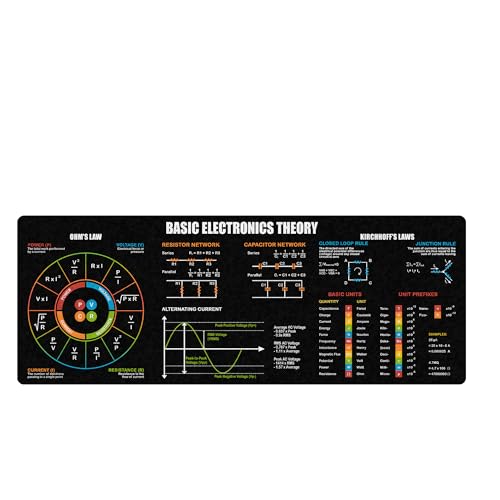
A 31.5×11.8 in printed circuit-reference mat that turns a desk you already own into a full-width work zone.
Best for: adding a full-width work surface to a desk you already own Skip it if: you need actual desk area, not a covering
This is the one add-on in the set with a genuine engineering angle rather than a joke. The surface is printed with basic electronic theory and circuit-design reference, so a quick check for a resistor colour code or a symbol happens without alt-tabbing to a browser. That's a small thing that repeats a hundred times a week.
The dimensions do real work too. At 31.5 x 11.8 in with a 3 mm thickness, it covers roughly half the width of any of the 63 in desks above, enough for a full keyboard and a mouse with room to sweep. TUYCORPUS lists a non-slip rubber base, invisible stitching to stop the edges fraying, and a water-resistant coating that wipes clean, which matters on a bench where coffee and flux both live. At 7.05 oz it's light enough to roll up and take to a lab.
It's also the only product in this entire lineup with a stated warranty period, listed at 1 month. That's short, and I'd rather see a year, but the other five publish nothing usable at all.
The honest limit: a mat adds no square inches. If your current desk is 40 in wide and cramped, this changes the feel and not the geometry. Buy it alongside one of the three desks, not instead of one.
Pros:
- 31.5×11.8 in, covers keyboard and mouse zone in one piece
- Printed circuit and electrical reference on the surface
- Only pick here with a stated warranty period, 1 month
- 3 mm thickness with non-slip rubber base
- Water-resistant coating, wipes clean after spills
Cons:
- Adds no usable desk area whatsoever
- 1 month warranty is the shortest useful term imaginable
- Only one seller lists it
- Fixed print, so the reference content is whatever ships
5. ZODGMED Funny Programmer Gifts for Men — Best for small spaces
At 5×5 in and just 0.2 in deep, it's the flattest thing here and fits a shelf with almost no clearance.

Best for: a cubicle shelf with almost no free depth Skip it if: you are shopping for a work surface
Set expectations properly: this is a decorative wooden sign, listed under Decorative Signs and Plaques, and it is not a desk. It earns its slot because the two signs in this set differ in one measurable way, and that difference decides which you'd choose.
This one is listed at 0.2 in deep against the GXLPO's 1.3 in box depth. Six times flatter, in other words. If the only free space in your cubicle is a monitor shelf already crowded with a headset stand and a coffee cup, 0.2 in fits where 1.3 in does not. ZODGMED says it stands on a flat surface without any bracket or stand, so nothing extra to lose in a drawer.
The face reads "The Code Doesn't Work Why", which lands with software engineers specifically rather than IT support generally. Material is listed as wood, described as burr-free with clear, non-toxic printing. Weight is 1.06 oz, identical to the other sign, and the colour variant is listed as P2.
The trade-offs are what you'd expect. It's the slowest-moving pick of all six, only one seller lists it, and the 0.2 in profile that makes it shelf-friendly also means it won't stand up to a bump the way a 1.3 in box will. And it holds the second-cheapest price position here while doing nothing functional at all.
Pros:
- Flattest item in this set at 0.2 in deep
- Stands unaided, no bracket or stand needed
- 5×5 in footprint fits a crowded monitor shelf
- Burr-free wood with non-toxic printing
- 1.06 oz, effectively weightless on a shelf
Cons:
- Not a desk and adds no work surface
- Thin 0.2 in profile tips easily if knocked
- Slowest-moving pick of the six
- No warranty published, single seller only
6. GXLPO Funny Tech Support Gifts for Women Men — Best budget pick
The cheapest pick of the six, a 5×5×1.3 in wooden box sign that can hang on a wall or stand on a counter.

Best for: a gift for a colleague who fields support tickets Skip it if: you want anything you can put a monitor on
The GXLPO sign is the cheapest of the six and, like the ZODGMED, it's a decoration rather than furniture. Its advantage over the other sign is the 1.3 in box depth. GXLPO describes a box-shape design that hangs on a wall or stands independently on a counter or table, and that extra depth is what makes wall mounting sensible. The 0.2 in ZODGMED has nothing to hang from.
The text reads "Have You Tried Turning It Off and On Again", which aims squarely at IT support and helpdesk work rather than software development. Pick between the two signs on the joke and the mounting method, because the specifications are otherwise near-identical: both 5×5 in faces, both 1.06 oz, both listed as wood with clear, non-toxic, fade-resistant printing. This one carries model GXLPO-311 and the colour variant is listed as A2.
Where it loses is exactly where you'd expect. It's the second-slowest seller here, only one seller lists it, and no warranty is published. And that 1.3 in depth cuts both ways: on a deep shelf it's stable, on a shallow one it protrudes where the ZODGMED wouldn't. Buy it as a desk-warming gift for someone who already owns a desk, and buy one of the three real desks above if the desk is the point.
Pros:
- Cheapest of the six picks
- 1.3 in box depth allows wall hanging or free standing
- 5×5 in face, 1.06 oz, fits any shelf
- Fade-resistant, non-toxic printing on wood
Cons:
- Provides no work surface of any kind
- 1.3 in depth protrudes on a shallow shelf
- Second-slowest seller in this lineup
- No warranty published, one seller only
How I weighted the criteria across six listings
I ranked these on four criteria, in this order of weight.
- Usable work surface, weighted heaviest. Square inches you can put a monitor on. This alone drops three of six picks to the bottom half.
- Depth, second. Monitor arms eat depth. 28 in versus 29.5 in changes where your keyboard sits.
- Adjustment and power, third. A motorised frame or built-in outlets each remove a daily annoyance. Only one pick has each.
- Published data completeness, fourth. A listing with weight, thickness and dimensions tells you what you're buying. A listing with three fields does not.
Why that order? Because in the best computer desk for engineers category, the failure mode is running out of room, not running out of features. Three monitors, a dock, a notebook and a mug is a lot of footprint, and no amount of cable management fixes a top that's too small.
Depth came second because it's the number buyers overlook. Everyone compares 63 in to 55 in. Almost nobody checks whether 28 in leaves room in front of an arm-mounted panel. Adjustment and power came third rather than first because they're genuinely optional: plenty of engineers sit all day and already own a good power strip. Data completeness came last but it broke the tie between the PRAISUN and the Huuger, since the Huuger publishes a 0.95 in top thickness and a 49 lb weight while the PRAISUN publishes neither.
Is a sit-stand frame worth it for long build sessions?
A sit-stand frame is worth it if your day includes stretches longer than two hours at the keyboard, and it's dead weight if it doesn't. Only the Veken offers one in this set, with an 18.2 in range from 28.3 in to 46.5 in and a claimed motor noise under 52 decibels.
Here's the trick with adjustable desks that spec sheets bury. The value isn't standing all day, which nobody does. It's the ability to move twice, mid-morning and mid-afternoon, without disassembling your workspace. A monitor arm, a dock and a mat all travel with the top.
Three conditions flip the recommendation away from the powered frame:
- Your usable width is under 63 in. All three desks here need 63 in of wall, and the Veken's frame needs clearance to rise. Measure before you order.
- You need more than two plugs at desk height. Take the Huuger. Four AC outlets plus USB-A and USB-C on the frame beats a motor if you're constantly plugging in test gear.
- You clamp a monitor arm and want maximum depth. The PRAISUN's 29.5 in gives you 1.5 in more than the Veken.
One more consideration specific to the Veken: the listing notes the desktop is made of joined pieces. If you plan to clamp anything heavy near a seam, that's worth a look at the assembly diagram first.
What these listings do not tell you
Three gaps run across this whole set, and knowing them keeps you from assuming a specification exists when it doesn't.
Load capacity is absent everywhere. Not one of the three desks publishes a weight rating in pounds. That's the number you'd actually want before mounting a dual-arm stand with two 27 in panels and a workstation tower on a shelf. What you get instead is descriptive language about steel tubes, crossbars and dual-beam frames. Useful direction, not a figure.
Warranty coverage is thin to nonexistent. The TUYCORPUS mat is the only pick with a stated term, and it's 1 month. The Veken's warranty field carries a country of origin rather than a period. The Huuger, the PRAISUN and both signs publish nothing. Register the product and keep your order confirmation, because that paperwork is your only recourse.
No cable management specifications. No grommet count, no tray, no channel dimensions on any of the three desks. The Huuger's built-in outlets are the closest thing to a cabling answer in this set, and they solve the plug problem rather than the routing problem. Budget for adhesive raceways.
Two smaller gaps worth naming: the PRAISUN publishes no shipping weight, so plan help for the unboxing, and none of the desks states a keyboard-tray mounting depth. Measure your tray's bracket before you order.
The verdict
If you run two or more monitors and spend full days at the keyboard, buy the Veken. A 63×28 in top with an electric range from 28.3 in to 46.5 in is the only combination here that gives you room and motion, and at 42.1 lb it's the lightest of the three desks to reposition once it's built. If you sit all day and your problem is plugs rather than posture, buy the Huuger. Four AC outlets, a USB-A port and a USB-C port on the frame plus a 0.95 in top and an L-shape you can reverse into either corner is the more practical bench, and it sits in the middle of this price range rather than the top.
The cutoff is your daily seated stretch. Under two hours at a time, the motor earns nothing and the Huuger's outlets earn something every single day. Over two hours, the Veken's 18.2 in of travel is what keeps your back working at 5pm.
The Huuger's exact advantage over the winner is power at desk height, and it's a real one. The Veken's exact advantage back is that no fixed desk can be raised when you're tired. Choose accordingly, and add the TUYCORPUS mat either way.
FAQ
Does the best computer desk for engineers need to be a standing desk?
The best computer desk for engineers doesn't need a standing frame, but the Veken's 28.3 in to 46.5 in range solves a problem fixed desks can't. If your working blocks run past two hours, that motion matters. If you sit for short bursts and want plugs at desk height, the Huuger's four AC outlets serve you better for less.
How much desk width do two monitors and a laptop actually need?
Two monitors and a laptop want the full 63 in you get from the Veken, Huuger and PRAISUN. Depth is the tighter constraint: at 28 in the Veken is the shallowest, while the PRAISUN gives you 29.5 in. If you clamp an arm to the back edge, that 1.5 in decides whether your keyboard sits comfortably or hangs over the front lip.
Is the Veken worth it over the cheaper PRAISUN desk?
Whether the Veken is worth it over the PRAISUN comes down to one feature. You get an electric frame with 18.2 in of travel and a claimed motor under 52 decibels, plus a published 42.1 lb weight. You give up 1.5 in of depth and pay the highest position in this set. If you never plan to stand, the PRAISUN's 29.5 in top wins.
Huuger L-shaped or Veken standing desk for a home lab?
Huuger L-shaped or Veken depends on what your lab plugs in. The Huuger gives four AC outlets, a USB-A and a USB-C on the frame, a 0.95 in top and a reversible corner return, all at 49 lb. The Veken gives motion instead. For a bench with a supply, a meter and a dock, the outlets win outright.
What mistake do first-time desk buyers make most often?
The mistake first-time desk buyers make is measuring wall width and forgetting depth, ceiling clearance and shipping weight. All three desks here need 63 in of wall. The Huuger arrives at 49 lb, which is awkward alone. And none of these listings publishes a load rating in pounds, so heavy monitor arms need your own judgment.
Start with a tape measure, not a shortlist. Check your usable wall run against 63 in, then check how much depth you have before a wall, radiator or window frame gets in the way. If both numbers clear, the Veken is the sensible default: it's the only pick that adapts to your body over the course of a day rather than making you adapt to it, and the 42.1 lb frame is manageable if you ever rearrange the room. Add the 31.5 in TUYCORPUS mat on top and you've covered the two things you touch most, the surface under your hands and the height it sits at.